CHAPTER 1:
The Drug Development Continuum, Preclinical to Market Access
Regulatory Affairs Professionals Society 5
As with generic medicines and biosimilars, DR leverages previ-
ously generated pharmacology, toxicology, and clinical and safety
data to identify potential DR opportunities, reducing development
time, cost, and rate of product failures in clinical development.
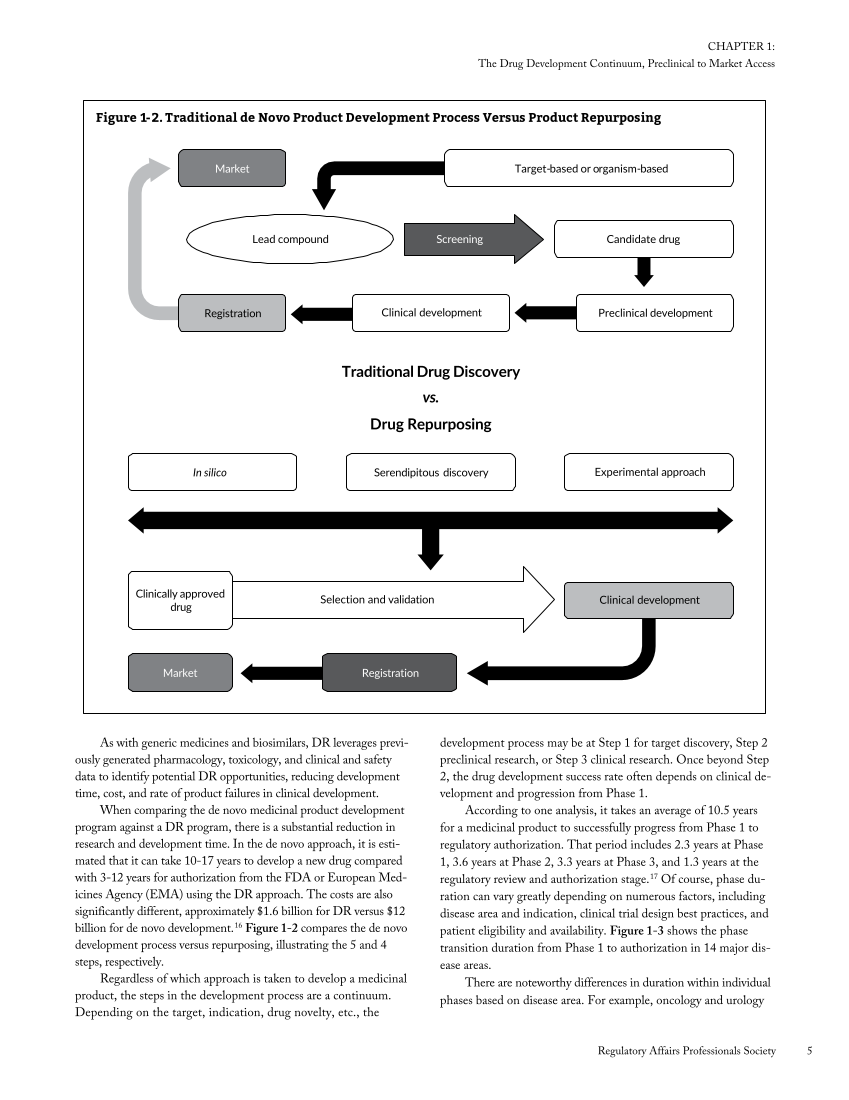
When comparing the de novo medicinal product development
program against a DR program, there is a substantial reduction in
research and development time. In the de novo approach, it is esti-
mated that it can take 10-17 years to develop a new drug compared
with 3-12 years for authorization from the FDA or European Med-
icines Agency (EMA) using the DR approach. The costs are also
significantly different, approximately $1.6 billion for DR versus $12
billion for de novo development.16 Figure 1-2 compares the de novo
development process versus repurposing, illustrating the 5 and 4
steps, respectively.
Regardless of which approach is taken to develop a medicinal
product, the steps in the development process are a continuum.
Depending on the target, indication, drug novelty, etc., the
development process may be at Step 1 for target discovery, Step 2
preclinical research, or Step 3 clinical research. Once beyond Step
2, the drug development success rate often depends on clinical de-
velopment and progression from Phase 1.
According to one analysis, it takes an average of 10.5 years
for a medicinal product to successfully progress from Phase 1 to
regulatory authorization. That period includes 2.3 years at Phase
1, 3.6 years at Phase 2, 3.3 years at Phase 3, and 1.3 years at the
regulatory review and authorization stage.17 Of course, phase du-
ration can vary greatly depending on numerous factors, including
disease area and indication, clinical trial design best practices, and
patient eligibility and availability. Figure 1-3 shows the phase
transition duration from Phase 1 to authorization in 14 major dis-
ease areas.
There are noteworthy differences in duration within individual
phases based on disease area. For example, oncology and urology
Lead compound Screening Candidate drug
Clinical development Preclinical development
Traditional Drug Discovery
vs.
Drug Repurposing
In silico Serendipitous discovery Experimental approach
Selection and validation Clinical development
Registration Market
Clinically approved
drug
Registration
Target-based or organism-based Market
Figure 1-2. Traditional de Novo Product Development Process Versus Product Repurposing
The Drug Development Continuum, Preclinical to Market Access
Regulatory Affairs Professionals Society 5
As with generic medicines and biosimilars, DR leverages previ-
ously generated pharmacology, toxicology, and clinical and safety
data to identify potential DR opportunities, reducing development
time, cost, and rate of product failures in clinical development.
When comparing the de novo medicinal product development
program against a DR program, there is a substantial reduction in
research and development time. In the de novo approach, it is esti-
mated that it can take 10-17 years to develop a new drug compared
with 3-12 years for authorization from the FDA or European Med-
icines Agency (EMA) using the DR approach. The costs are also
significantly different, approximately $1.6 billion for DR versus $12
billion for de novo development.16 Figure 1-2 compares the de novo
development process versus repurposing, illustrating the 5 and 4
steps, respectively.
Regardless of which approach is taken to develop a medicinal
product, the steps in the development process are a continuum.
Depending on the target, indication, drug novelty, etc., the
development process may be at Step 1 for target discovery, Step 2
preclinical research, or Step 3 clinical research. Once beyond Step
2, the drug development success rate often depends on clinical de-
velopment and progression from Phase 1.
According to one analysis, it takes an average of 10.5 years
for a medicinal product to successfully progress from Phase 1 to
regulatory authorization. That period includes 2.3 years at Phase
1, 3.6 years at Phase 2, 3.3 years at Phase 3, and 1.3 years at the
regulatory review and authorization stage.17 Of course, phase du-
ration can vary greatly depending on numerous factors, including
disease area and indication, clinical trial design best practices, and
patient eligibility and availability. Figure 1-3 shows the phase
transition duration from Phase 1 to authorization in 14 major dis-
ease areas.
There are noteworthy differences in duration within individual
phases based on disease area. For example, oncology and urology
Lead compound Screening Candidate drug
Clinical development Preclinical development
Traditional Drug Discovery
vs.
Drug Repurposing
In silico Serendipitous discovery Experimental approach
Selection and validation Clinical development
Registration Market
Clinically approved
drug
Registration
Target-based or organism-based Market
Figure 1-2. Traditional de Novo Product Development Process Versus Product Repurposing