Regulatory Intelligence Reimagined
5 Regulatory Affairs Professionals Society
capabilities, providing a cohesive structure for RI that can be
applied across various regulatory affairs functions.
General Framework for RI
Although the detail of their work varies, these regulatory
affairs functions exhibit four common features that serve as
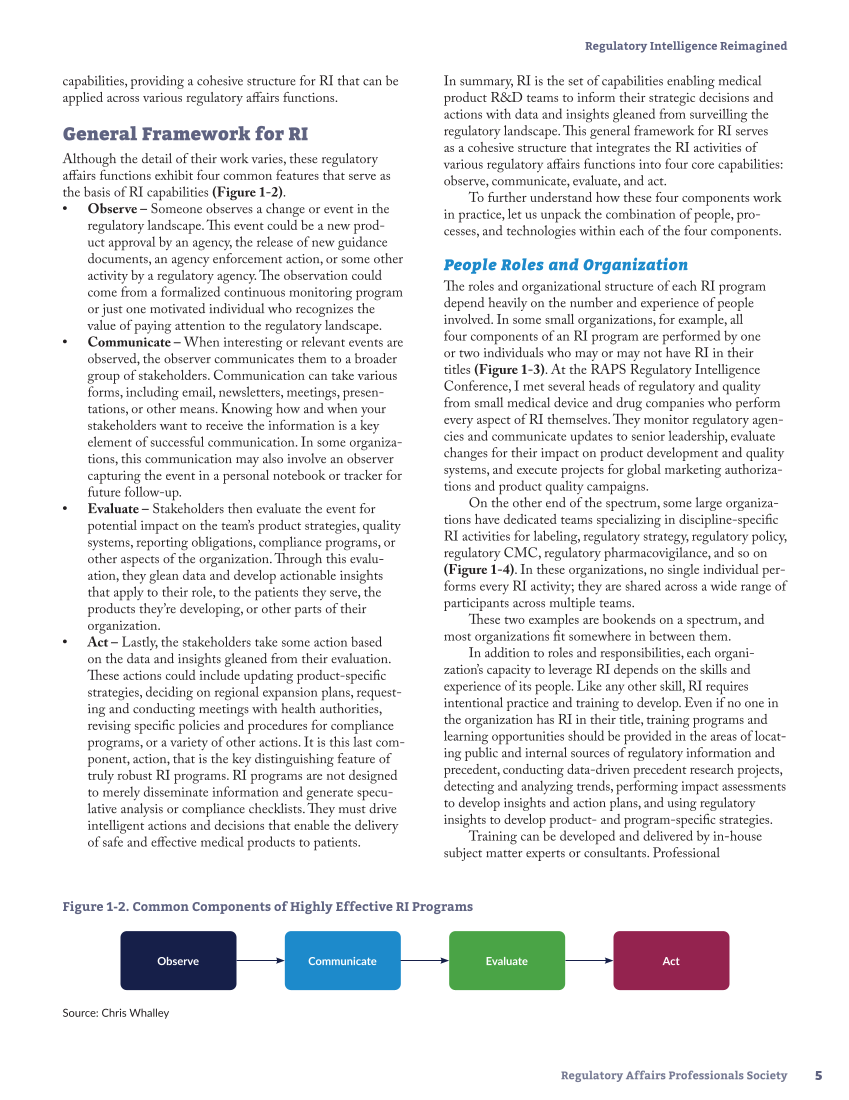
the basis of RI capabilities (Figure 1-2).
• Observe – Someone observes a change or event in the
regulatory landscape. This event could be a new prod‑
uct approval by an agency, the release of new guidance
documents, an agency enforcement action, or some other
activity by a regulatory agency. The observation could
come from a formalized continuous monitoring program
or just one motivated individual who recognizes the
value of paying attention to the regulatory landscape.
• Communicate – When interesting or relevant events are
observed, the observer communicates them to a broader
group of stakeholders. Communication can take various
forms, including email, newsletters, meetings, presen‑
tations, or other means. Knowing how and when your
stakeholders want to receive the information is a key
element of successful communication. In some organiza‑
tions, this communication may also involve an observer
capturing the event in a personal notebook or tracker for
future follow-up.
• Evaluate – Stakeholders then evaluate the event for
potential impact on the team’s product strategies, quality
systems, reporting obligations, compliance programs, or
other aspects of the organization. Through this evalu‑
ation, they glean data and develop actionable insights
that apply to their role, to the patients they serve, the
products they’re developing, or other parts of their
organization.
• Act – Lastly, the stakeholders take some action based
on the data and insights gleaned from their evaluation.
These actions could include updating product-specific
strategies, deciding on regional expansion plans, request‑
ing and conducting meetings with health authorities,
revising specific policies and procedures for compliance
programs, or a variety of other actions. It is this last com‑
ponent, action, that is the key distinguishing feature of
truly robust RI programs. RI programs are not designed
to merely disseminate information and generate specu‑
lative analysis or compliance checklists. They must drive
intelligent actions and decisions that enable the delivery
of safe and effective medical products to patients.
In summary, RI is the set of capabilities enabling medical
product R&D teams to inform their strategic decisions and
actions with data and insights gleaned from surveilling the
regulatory landscape. This general framework for RI serves
as a cohesive structure that integrates the RI activities of
various regulatory affairs functions into four core capabilities:
observe, communicate, evaluate, and act.
To further understand how these four components work
in practice, let us unpack the combination of people, pro‑
cesses, and technologies within each of the four components.
People Roles and Organization
The roles and organizational structure of each RI program
depend heavily on the number and experience of people
involved. In some small organizations, for example, all
four components of an RI program are performed by one
or two individuals who may or may not have RI in their
titles (Figure 1-3). At the RAPS Regulatory Intelligence
Conference, I met several heads of regulatory and quality
from small medical device and drug companies who perform
every aspect of RI themselves. They monitor regulatory agen‑
cies and communicate updates to senior leadership, evaluate
changes for their impact on product development and quality
systems, and execute projects for global marketing authoriza‑
tions and product quality campaigns.
On the other end of the spectrum, some large organiza‑
tions have dedicated teams specializing in discipline-specific
RI activities for labeling, regulatory strategy, regulatory policy,
regulatory CMC, regulatory pharmacovigilance, and so on
(Figure 1-4). In these organizations, no single individual per‑
forms every RI activity they are shared across a wide range of
participants across multiple teams.
These two examples are bookends on a spectrum, and
most organizations fit somewhere in between them.
In addition to roles and responsibilities, each organi‑
zation’s capacity to leverage RI depends on the skills and
experience of its people. Like any other skill, RI requires
intentional practice and training to develop. Even if no one in
the organization has RI in their title, training programs and
learning opportunities should be provided in the areas of locat‑
ing public and internal sources of regulatory information and
precedent, conducting data-driven precedent research projects,
detecting and analyzing trends, performing impact assessments
to develop insights and action plans, and using regulatory
insights to develop product- and program-specific strategies.
Training can be developed and delivered by in-house
subject matter experts or consultants. Professional
Figure 1-2. Common Components of Highly Effective RI Programs
Observe Communicate Evaluate Act
Source: Chris Whalley
5 Regulatory Affairs Professionals Society
capabilities, providing a cohesive structure for RI that can be
applied across various regulatory affairs functions.
General Framework for RI
Although the detail of their work varies, these regulatory
affairs functions exhibit four common features that serve as
the basis of RI capabilities (Figure 1-2).
• Observe – Someone observes a change or event in the
regulatory landscape. This event could be a new prod‑
uct approval by an agency, the release of new guidance
documents, an agency enforcement action, or some other
activity by a regulatory agency. The observation could
come from a formalized continuous monitoring program
or just one motivated individual who recognizes the
value of paying attention to the regulatory landscape.
• Communicate – When interesting or relevant events are
observed, the observer communicates them to a broader
group of stakeholders. Communication can take various
forms, including email, newsletters, meetings, presen‑
tations, or other means. Knowing how and when your
stakeholders want to receive the information is a key
element of successful communication. In some organiza‑
tions, this communication may also involve an observer
capturing the event in a personal notebook or tracker for
future follow-up.
• Evaluate – Stakeholders then evaluate the event for
potential impact on the team’s product strategies, quality
systems, reporting obligations, compliance programs, or
other aspects of the organization. Through this evalu‑
ation, they glean data and develop actionable insights
that apply to their role, to the patients they serve, the
products they’re developing, or other parts of their
organization.
• Act – Lastly, the stakeholders take some action based
on the data and insights gleaned from their evaluation.
These actions could include updating product-specific
strategies, deciding on regional expansion plans, request‑
ing and conducting meetings with health authorities,
revising specific policies and procedures for compliance
programs, or a variety of other actions. It is this last com‑
ponent, action, that is the key distinguishing feature of
truly robust RI programs. RI programs are not designed
to merely disseminate information and generate specu‑
lative analysis or compliance checklists. They must drive
intelligent actions and decisions that enable the delivery
of safe and effective medical products to patients.
In summary, RI is the set of capabilities enabling medical
product R&D teams to inform their strategic decisions and
actions with data and insights gleaned from surveilling the
regulatory landscape. This general framework for RI serves
as a cohesive structure that integrates the RI activities of
various regulatory affairs functions into four core capabilities:
observe, communicate, evaluate, and act.
To further understand how these four components work
in practice, let us unpack the combination of people, pro‑
cesses, and technologies within each of the four components.
People Roles and Organization
The roles and organizational structure of each RI program
depend heavily on the number and experience of people
involved. In some small organizations, for example, all
four components of an RI program are performed by one
or two individuals who may or may not have RI in their
titles (Figure 1-3). At the RAPS Regulatory Intelligence
Conference, I met several heads of regulatory and quality
from small medical device and drug companies who perform
every aspect of RI themselves. They monitor regulatory agen‑
cies and communicate updates to senior leadership, evaluate
changes for their impact on product development and quality
systems, and execute projects for global marketing authoriza‑
tions and product quality campaigns.
On the other end of the spectrum, some large organiza‑
tions have dedicated teams specializing in discipline-specific
RI activities for labeling, regulatory strategy, regulatory policy,
regulatory CMC, regulatory pharmacovigilance, and so on
(Figure 1-4). In these organizations, no single individual per‑
forms every RI activity they are shared across a wide range of
participants across multiple teams.
These two examples are bookends on a spectrum, and
most organizations fit somewhere in between them.
In addition to roles and responsibilities, each organi‑
zation’s capacity to leverage RI depends on the skills and
experience of its people. Like any other skill, RI requires
intentional practice and training to develop. Even if no one in
the organization has RI in their title, training programs and
learning opportunities should be provided in the areas of locat‑
ing public and internal sources of regulatory information and
precedent, conducting data-driven precedent research projects,
detecting and analyzing trends, performing impact assessments
to develop insights and action plans, and using regulatory
insights to develop product- and program-specific strategies.
Training can be developed and delivered by in-house
subject matter experts or consultants. Professional
Figure 1-2. Common Components of Highly Effective RI Programs
Observe Communicate Evaluate Act
Source: Chris Whalley