Fundamentals of Pharmaceutical and Biologics Regulations: A Global Perspective
Second Edition
12 Regulatory Affairs Professionals Society
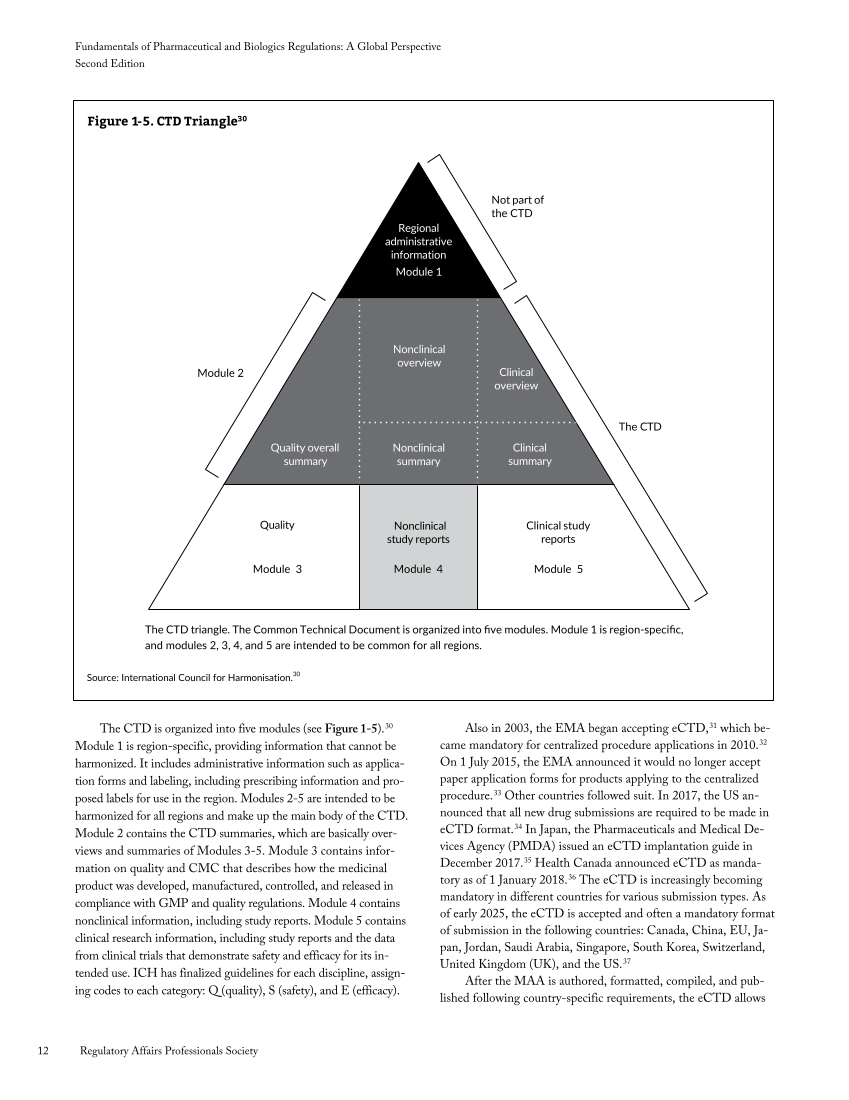
The CTD is organized into five modules (see Figure 1-5).30
Module 1 is region-specific, providing information that cannot be
harmonized. It includes administrative information such as applica-
tion forms and labeling, including prescribing information and pro-
posed labels for use in the region. Modules 2-5 are intended to be
harmonized for all regions and make up the main body of the CTD.
Module 2 contains the CTD summaries, which are basically over-
views and summaries of Modules 3-5. Module 3 contains infor-
mation on quality and CMC that describes how the medicinal
product was developed, manufactured, controlled, and released in
compliance with GMP and quality regulations. Module 4 contains
nonclinical information, including study reports. Module 5 contains
clinical research information, including study reports and the data
from clinical trials that demonstrate safety and efficacy for its in-
tended use. ICH has finalized guidelines for each discipline, assign-
ing codes to each category: Q (quality), S (safety), and E (efficacy).
Also in 2003, the EMA began accepting eCTD,31 which be-
came mandatory for centralized procedure applications in 2010.32
On 1 July 2015, the EMA announced it would no longer accept
paper application forms for products applying to the centralized
procedure.33 Other countries followed suit. In 2017, the US an-
nounced that all new drug submissions are required to be made in
eCTD format.34 In Japan, the Pharmaceuticals and Medical De-
vices Agency (PMDA) issued an eCTD implantation guide in
December 2017.35 Health Canada announced eCTD as manda-
tory as of 1 January 2018.36 The eCTD is increasingly becoming
mandatory in different countries for various submission types. As
of early 2025, the eCTD is accepted and often a mandatory format
of submission in the following countries: Canada, China, EU, Ja-
pan, Jordan, Saudi Arabia, Singapore, South Korea, Switzerland,
United Kingdom (UK), and the US.37
After the MAA is authored, formatted, compiled, and pub-
lished following country-specific requirements, the eCTD allows
Not part of
the CTD
Regional
administrative
information
Module 1
Module 2
Nonclinical
overview
Clinical
overview
The CTD
Quality overall
summary
Nonclinical
summary
Clinical
summary
Quality Nonclinical
study reports
Clinical study
reports
Module 3 Module 4 Module 5
The CTD triangle. The Common Technical Document is organized into five modules. Module 1 is region-specific,
and modules 2, 3, 4, and 5 are intended to be common for all regions.
Source: International Council for Harmonisation.30
Figure 1-5. CTD Triangle30
Second Edition
12 Regulatory Affairs Professionals Society
The CTD is organized into five modules (see Figure 1-5).30
Module 1 is region-specific, providing information that cannot be
harmonized. It includes administrative information such as applica-
tion forms and labeling, including prescribing information and pro-
posed labels for use in the region. Modules 2-5 are intended to be
harmonized for all regions and make up the main body of the CTD.
Module 2 contains the CTD summaries, which are basically over-
views and summaries of Modules 3-5. Module 3 contains infor-
mation on quality and CMC that describes how the medicinal
product was developed, manufactured, controlled, and released in
compliance with GMP and quality regulations. Module 4 contains
nonclinical information, including study reports. Module 5 contains
clinical research information, including study reports and the data
from clinical trials that demonstrate safety and efficacy for its in-
tended use. ICH has finalized guidelines for each discipline, assign-
ing codes to each category: Q (quality), S (safety), and E (efficacy).
Also in 2003, the EMA began accepting eCTD,31 which be-
came mandatory for centralized procedure applications in 2010.32
On 1 July 2015, the EMA announced it would no longer accept
paper application forms for products applying to the centralized
procedure.33 Other countries followed suit. In 2017, the US an-
nounced that all new drug submissions are required to be made in
eCTD format.34 In Japan, the Pharmaceuticals and Medical De-
vices Agency (PMDA) issued an eCTD implantation guide in
December 2017.35 Health Canada announced eCTD as manda-
tory as of 1 January 2018.36 The eCTD is increasingly becoming
mandatory in different countries for various submission types. As
of early 2025, the eCTD is accepted and often a mandatory format
of submission in the following countries: Canada, China, EU, Ja-
pan, Jordan, Saudi Arabia, Singapore, South Korea, Switzerland,
United Kingdom (UK), and the US.37
After the MAA is authored, formatted, compiled, and pub-
lished following country-specific requirements, the eCTD allows
Not part of
the CTD
Regional
administrative
information
Module 1
Module 2
Nonclinical
overview
Clinical
overview
The CTD
Quality overall
summary
Nonclinical
summary
Clinical
summary
Quality Nonclinical
study reports
Clinical study
reports
Module 3 Module 4 Module 5
The CTD triangle. The Common Technical Document is organized into five modules. Module 1 is region-specific,
and modules 2, 3, 4, and 5 are intended to be common for all regions.
Source: International Council for Harmonisation.30
Figure 1-5. CTD Triangle30