Fundamentals of Pharmaceutical and Biologics Regulations: A Global Perspective
Second Edition
8 Regulatory Affairs Professionals Society
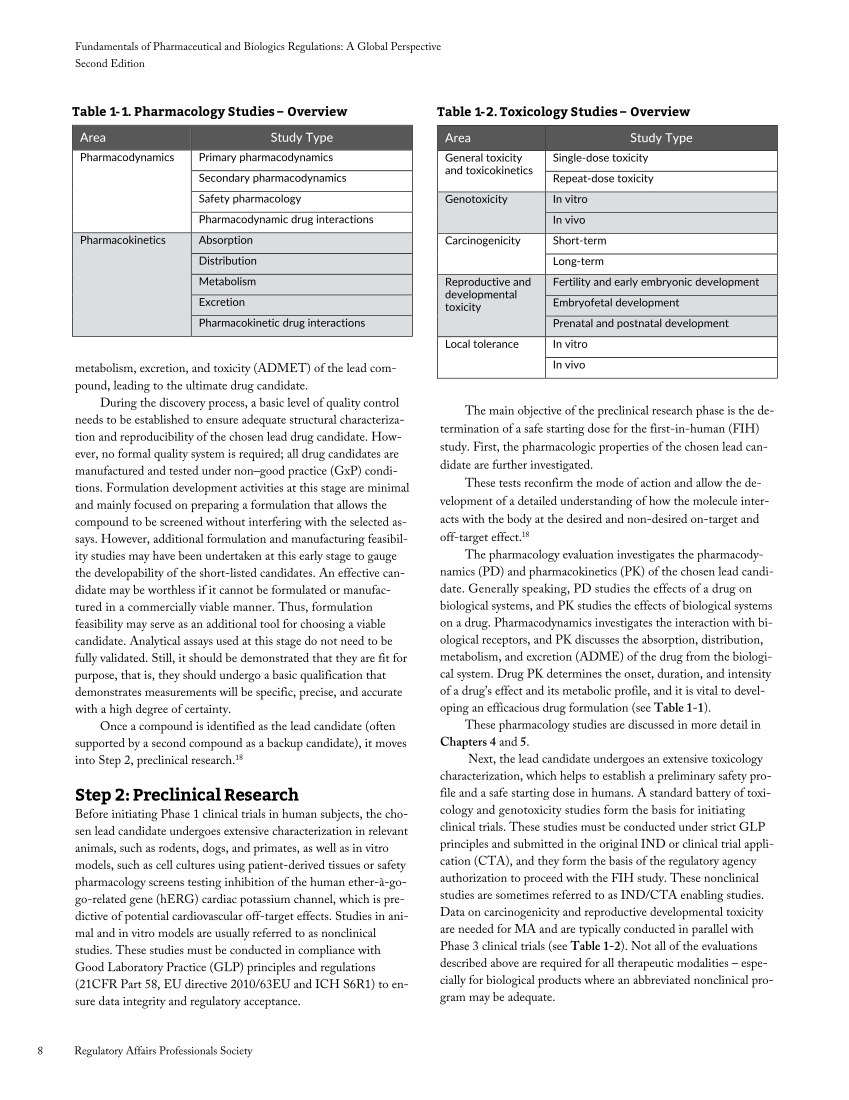
Table 1-1. Pharmacology Studies – Overview
Area Study Type
Pharmacodynamics Primary pharmacodynamics
Secondary pharmacodynamics
Safety pharmacology
Pharmacodynamic drug interactions
Pharmacokinetics Absorption
Distribution
Metabolism
Excretion
Pharmacokinetic drug interactions
metabolism, excretion, and toxicity (ADMET) of the lead com-
pound, leading to the ultimate drug candidate.
During the discovery process, a basic level of quality control
needs to be established to ensure adequate structural characteriza-
tion and reproducibility of the chosen lead drug candidate. How-
ever, no formal quality system is required all drug candidates are
manufactured and tested under non–good practice (GxP) condi-
tions. Formulation development activities at this stage are minimal
and mainly focused on preparing a formulation that allows the
compound to be screened without interfering with the selected as-
says. However, additional formulation and manufacturing feasibil-
ity studies may have been undertaken at this early stage to gauge
the developability of the short-listed candidates. An effective can-
didate may be worthless if it cannot be formulated or manufac-
tured in a commercially viable manner. Thus, formulation
feasibility may serve as an additional tool for choosing a viable
candidate. Analytical assays used at this stage do not need to be
fully validated. Still, it should be demonstrated that they are fit for
purpose, that is, they should undergo a basic qualification that
demonstrates measurements will be specific, precise, and accurate
with a high degree of certainty.
Once a compound is identified as the lead candidate (often
supported by a second compound as a backup candidate), it moves
into Step 2, preclinical research.18
Step 2: Preclinical Research
Before initiating Phase 1 clinical trials in human subjects, the cho-
sen lead candidate undergoes extensive characterization in relevant
animals, such as rodents, dogs, and primates, as well as in vitro
models, such as cell cultures using patient-derived tissues or safety
pharmacology screens testing inhibition of the human ether-à-go-
go-related gene (hERG) cardiac potassium channel, which is pre-
dictive of potential cardiovascular off-target effects. Studies in ani-
mal and in vitro models are usually referred to as nonclinical
studies. These studies must be conducted in compliance with
Good Laboratory Practice (GLP) principles and regulations
(21CFR Part 58, EU directive 2010/63EU and ICH S6R1) to en-
sure data integrity and regulatory acceptance.
Table 1-2. Toxicology Studies – Overview
Area Study Type
General toxicity
and toxicokinetics
Single-dose toxicity
Repeat-dose toxicity
Genotoxicity In vitro
In vivo
Carcinogenicity Short-term
Long-term
Reproductive and
developmental
toxicity
Fertility and early embryonic development
Embryofetal development
Prenatal and postnatal development
Local tolerance In vitro
In vivo
The main objective of the preclinical research phase is the de-
termination of a safe starting dose for the first-in-human (FIH)
study. First, the pharmacologic properties of the chosen lead can-
didate are further investigated.
These tests reconfirm the mode of action and allow the de-
velopment of a detailed understanding of how the molecule inter-
acts with the body at the desired and non-desired on-target and
off-target effect.18
The pharmacology evaluation investigates the pharmacody-
namics (PD) and pharmacokinetics (PK) of the chosen lead candi-
date. Generally speaking, PD studies the effects of a drug on
biological systems, and PK studies the effects of biological systems
on a drug. Pharmacodynamics investigates the interaction with bi-
ological receptors, and PK discusses the absorption, distribution,
metabolism, and excretion (ADME) of the drug from the biologi-
cal system. Drug PK determines the onset, duration, and intensity
of a drug’s effect and its metabolic profile, and it is vital to devel-
oping an efficacious drug formulation (see Table 1-1).
These pharmacology studies are discussed in more detail in
Chapters 4 and 5.
Next, the lead candidate undergoes an extensive toxicology
characterization, which helps to establish a preliminary safety pro-
file and a safe starting dose in humans. A standard battery of toxi-
cology and genotoxicity studies form the basis for initiating
clinical trials. These studies must be conducted under strict GLP
principles and submitted in the original IND or clinical trial appli-
cation (CTA), and they form the basis of the regulatory agency
authorization to proceed with the FIH study. These nonclinical
studies are sometimes referred to as IND/CTA enabling studies.
Data on carcinogenicity and reproductive developmental toxicity
are needed for MA and are typically conducted in parallel with
Phase 3 clinical trials (see Table 1-2). Not all of the evaluations
described above are required for all therapeutic modalities – espe-
cially for biological products where an abbreviated nonclinical pro-
gram may be adequate.
Second Edition
8 Regulatory Affairs Professionals Society
Table 1-1. Pharmacology Studies – Overview
Area Study Type
Pharmacodynamics Primary pharmacodynamics
Secondary pharmacodynamics
Safety pharmacology
Pharmacodynamic drug interactions
Pharmacokinetics Absorption
Distribution
Metabolism
Excretion
Pharmacokinetic drug interactions
metabolism, excretion, and toxicity (ADMET) of the lead com-
pound, leading to the ultimate drug candidate.
During the discovery process, a basic level of quality control
needs to be established to ensure adequate structural characteriza-
tion and reproducibility of the chosen lead drug candidate. How-
ever, no formal quality system is required all drug candidates are
manufactured and tested under non–good practice (GxP) condi-
tions. Formulation development activities at this stage are minimal
and mainly focused on preparing a formulation that allows the
compound to be screened without interfering with the selected as-
says. However, additional formulation and manufacturing feasibil-
ity studies may have been undertaken at this early stage to gauge
the developability of the short-listed candidates. An effective can-
didate may be worthless if it cannot be formulated or manufac-
tured in a commercially viable manner. Thus, formulation
feasibility may serve as an additional tool for choosing a viable
candidate. Analytical assays used at this stage do not need to be
fully validated. Still, it should be demonstrated that they are fit for
purpose, that is, they should undergo a basic qualification that
demonstrates measurements will be specific, precise, and accurate
with a high degree of certainty.
Once a compound is identified as the lead candidate (often
supported by a second compound as a backup candidate), it moves
into Step 2, preclinical research.18
Step 2: Preclinical Research
Before initiating Phase 1 clinical trials in human subjects, the cho-
sen lead candidate undergoes extensive characterization in relevant
animals, such as rodents, dogs, and primates, as well as in vitro
models, such as cell cultures using patient-derived tissues or safety
pharmacology screens testing inhibition of the human ether-à-go-
go-related gene (hERG) cardiac potassium channel, which is pre-
dictive of potential cardiovascular off-target effects. Studies in ani-
mal and in vitro models are usually referred to as nonclinical
studies. These studies must be conducted in compliance with
Good Laboratory Practice (GLP) principles and regulations
(21CFR Part 58, EU directive 2010/63EU and ICH S6R1) to en-
sure data integrity and regulatory acceptance.
Table 1-2. Toxicology Studies – Overview
Area Study Type
General toxicity
and toxicokinetics
Single-dose toxicity
Repeat-dose toxicity
Genotoxicity In vitro
In vivo
Carcinogenicity Short-term
Long-term
Reproductive and
developmental
toxicity
Fertility and early embryonic development
Embryofetal development
Prenatal and postnatal development
Local tolerance In vitro
In vivo
The main objective of the preclinical research phase is the de-
termination of a safe starting dose for the first-in-human (FIH)
study. First, the pharmacologic properties of the chosen lead can-
didate are further investigated.
These tests reconfirm the mode of action and allow the de-
velopment of a detailed understanding of how the molecule inter-
acts with the body at the desired and non-desired on-target and
off-target effect.18
The pharmacology evaluation investigates the pharmacody-
namics (PD) and pharmacokinetics (PK) of the chosen lead candi-
date. Generally speaking, PD studies the effects of a drug on
biological systems, and PK studies the effects of biological systems
on a drug. Pharmacodynamics investigates the interaction with bi-
ological receptors, and PK discusses the absorption, distribution,
metabolism, and excretion (ADME) of the drug from the biologi-
cal system. Drug PK determines the onset, duration, and intensity
of a drug’s effect and its metabolic profile, and it is vital to devel-
oping an efficacious drug formulation (see Table 1-1).
These pharmacology studies are discussed in more detail in
Chapters 4 and 5.
Next, the lead candidate undergoes an extensive toxicology
characterization, which helps to establish a preliminary safety pro-
file and a safe starting dose in humans. A standard battery of toxi-
cology and genotoxicity studies form the basis for initiating
clinical trials. These studies must be conducted under strict GLP
principles and submitted in the original IND or clinical trial appli-
cation (CTA), and they form the basis of the regulatory agency
authorization to proceed with the FIH study. These nonclinical
studies are sometimes referred to as IND/CTA enabling studies.
Data on carcinogenicity and reproductive developmental toxicity
are needed for MA and are typically conducted in parallel with
Phase 3 clinical trials (see Table 1-2). Not all of the evaluations
described above are required for all therapeutic modalities – espe-
cially for biological products where an abbreviated nonclinical pro-
gram may be adequate.