5
chapter 2 The Drug Development Continuum,
Preclinical to Market Access
Darlene Rosario, MBA, RAC-US Pragnesh Donga, MPharm, MBA, RAC-Drugs
Kathrin Schalper, PhD, RAC-US, RAC-EU, RAC-Canada, RAC-Devices
T
he medicinal product development process, from discovery
through clinical investigation and ultimately to the market,
follows specific steps. The collective steps often are referred
to as the product development continuum or de novo product
development. This chapter will identify the steps in the product
development continuum of new (novel) pharmaceuticals and
biopharmaceuticals.
A Five-Step Process
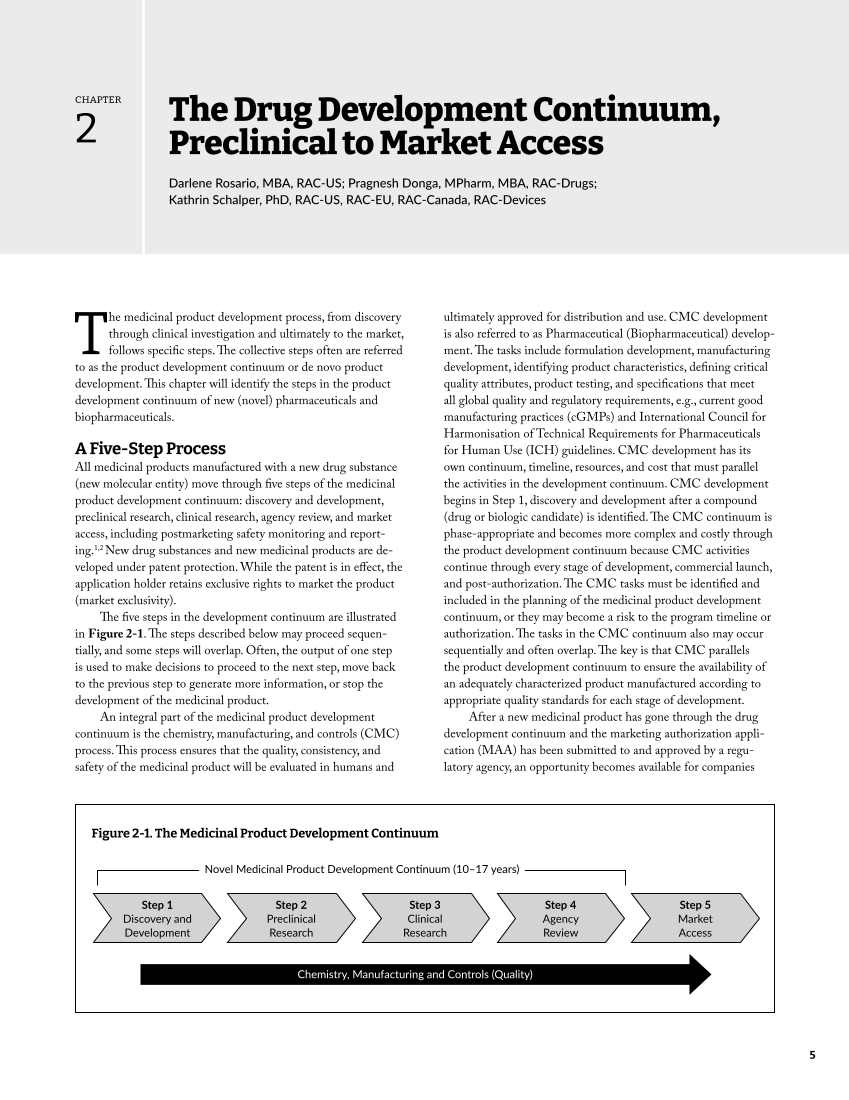
All medicinal products manufactured with a new drug substance
(new molecular entity) move through five steps of the medicinal
product development continuum: discovery and development,
preclinical research, clinical research, agency review, and market
access, including postmarketing safety monitoring and report-
ing.1,2 New drug substances and new medicinal products are de-
veloped under patent protection. While the patent is in effect, the
application holder retains exclusive rights to market the product
(market exclusivity).
The five steps in the development continuum are illustrated
in Figure 2-1. The steps described below may proceed sequen-
tially, and some steps will overlap. Often, the output of one step
is used to make decisions to proceed to the next step, move back
to the previous step to generate more information, or stop the
development of the medicinal product.
An integral part of the medicinal product development
continuum is the chemistry, manufacturing, and controls (CMC)
process. This process ensures that the quality, consistency, and
safety of the medicinal product will be evaluated in humans and
ultimately approved for distribution and use. CMC development
is also referred to as Pharmaceutical (Biopharmaceutical) develop-
ment. The tasks include formulation development, manufacturing
development, identifying product characteristics, defining critical
quality attributes, product testing, and specifications that meet
all global quality and regulatory requirements, e.g., current good
manufacturing practices (cGMPs) and International Council for
Harmonisation of Technical Requirements for Pharmaceuticals
for Human Use (ICH) guidelines. CMC development has its
own continuum, timeline, resources, and cost that must parallel
the activities in the development continuum. CMC development
begins in Step 1, discovery and development after a compound
(drug or biologic candidate) is identified. The CMC continuum is
phase-appropriate and becomes more complex and costly through
the product development continuum because CMC activities
continue through every stage of development, commercial launch,
and post-authorization. The CMC tasks must be identified and
included in the planning of the medicinal product development
continuum, or they may become a risk to the program timeline or
authorization. The tasks in the CMC continuum also may occur
sequentially and often overlap. The key is that CMC parallels
the product development continuum to ensure the availability of
an adequately characterized product manufactured according to
appropriate quality standards for each stage of development.
After a new medicinal product has gone through the drug
development continuum and the marketing authorization appli-
cation (MAA) has been submitted to and approved by a regu-
latory agency, an opportunity becomes available for companies
Figure 2-1. The Medicinal Product Development Continuum
Step 1
Discovery and
Development
Step 2
Preclinical
Research
Step 3
Clinical
Research
Step 4
Agency
Review
Step 5
Market
Access
Novel Medicinal Product Development Continuum (10–17 years)
Chemistry, Manufacturing and Controls (Quality)
chapter 2 The Drug Development Continuum,
Preclinical to Market Access
Darlene Rosario, MBA, RAC-US Pragnesh Donga, MPharm, MBA, RAC-Drugs
Kathrin Schalper, PhD, RAC-US, RAC-EU, RAC-Canada, RAC-Devices
T
he medicinal product development process, from discovery
through clinical investigation and ultimately to the market,
follows specific steps. The collective steps often are referred
to as the product development continuum or de novo product
development. This chapter will identify the steps in the product
development continuum of new (novel) pharmaceuticals and
biopharmaceuticals.
A Five-Step Process
All medicinal products manufactured with a new drug substance
(new molecular entity) move through five steps of the medicinal
product development continuum: discovery and development,
preclinical research, clinical research, agency review, and market
access, including postmarketing safety monitoring and report-
ing.1,2 New drug substances and new medicinal products are de-
veloped under patent protection. While the patent is in effect, the
application holder retains exclusive rights to market the product
(market exclusivity).
The five steps in the development continuum are illustrated
in Figure 2-1. The steps described below may proceed sequen-
tially, and some steps will overlap. Often, the output of one step
is used to make decisions to proceed to the next step, move back
to the previous step to generate more information, or stop the
development of the medicinal product.
An integral part of the medicinal product development
continuum is the chemistry, manufacturing, and controls (CMC)
process. This process ensures that the quality, consistency, and
safety of the medicinal product will be evaluated in humans and
ultimately approved for distribution and use. CMC development
is also referred to as Pharmaceutical (Biopharmaceutical) develop-
ment. The tasks include formulation development, manufacturing
development, identifying product characteristics, defining critical
quality attributes, product testing, and specifications that meet
all global quality and regulatory requirements, e.g., current good
manufacturing practices (cGMPs) and International Council for
Harmonisation of Technical Requirements for Pharmaceuticals
for Human Use (ICH) guidelines. CMC development has its
own continuum, timeline, resources, and cost that must parallel
the activities in the development continuum. CMC development
begins in Step 1, discovery and development after a compound
(drug or biologic candidate) is identified. The CMC continuum is
phase-appropriate and becomes more complex and costly through
the product development continuum because CMC activities
continue through every stage of development, commercial launch,
and post-authorization. The CMC tasks must be identified and
included in the planning of the medicinal product development
continuum, or they may become a risk to the program timeline or
authorization. The tasks in the CMC continuum also may occur
sequentially and often overlap. The key is that CMC parallels
the product development continuum to ensure the availability of
an adequately characterized product manufactured according to
appropriate quality standards for each stage of development.
After a new medicinal product has gone through the drug
development continuum and the marketing authorization appli-
cation (MAA) has been submitted to and approved by a regu-
latory agency, an opportunity becomes available for companies
Figure 2-1. The Medicinal Product Development Continuum
Step 1
Discovery and
Development
Step 2
Preclinical
Research
Step 3
Clinical
Research
Step 4
Agency
Review
Step 5
Market
Access
Novel Medicinal Product Development Continuum (10–17 years)
Chemistry, Manufacturing and Controls (Quality)