19
Lifecycle Management Through the Rx-to-OTC Switch
the current labeling constraints and challenges,
may need to be evaluated for convenience against
these telemedicine alternatives.
Assessing Rx-to-OTC Switch Value —
Ability to Build Awareness, Trial, and
Repeat
When a product switches to OTC, consumers
must be aware of its existence to consider making
a purchase, as the healthcare professional no longer
remains the gatekeeper. Well-known brands bring
with them a strong prescription brand equity (and
user base) and inherent trust (“millions of prescrip-
tions have been written …”) that help build instant
awareness and commercial value.
For this reason, OTC brands keep some
aspect of the Rx brand’s trademark, even when
only part of the Rx brand’s indication, dose, pop-
ulation, or dosage form switches (a partial switch).
Proton pump inhibitors (PPIs) like Nexium were
approved OTC for treatment of frequent heart-
burn, but this indication was not an Rx indication
Nexium remains indicated as a prescription
product for treatment of conditions that cannot
be self-diagnosed, such as gastroesophageal reflux
disease or H. pylori eradication to reduce the risk
of duodenal ulcer recurrence. While consumers
refer to the product as “Nexium,” the OTC prod-
uct is actually “Nexium 24HR.” This name allowed
Nexium to retain its brand equity and convey the
long-lasting benefits of the product to consumers.
“The purple pill” also transitioned its trademark
color to the OTC product.
Imagery is key: when Rhinocort switched
to OTC, it had relatively poor brand awareness.
The OTC package relied heavily on the colors
and imagery of Zyrtec as an attempt to generate
consumer trust. However, brands cannot rely
solely on the strength of their Rx equity.
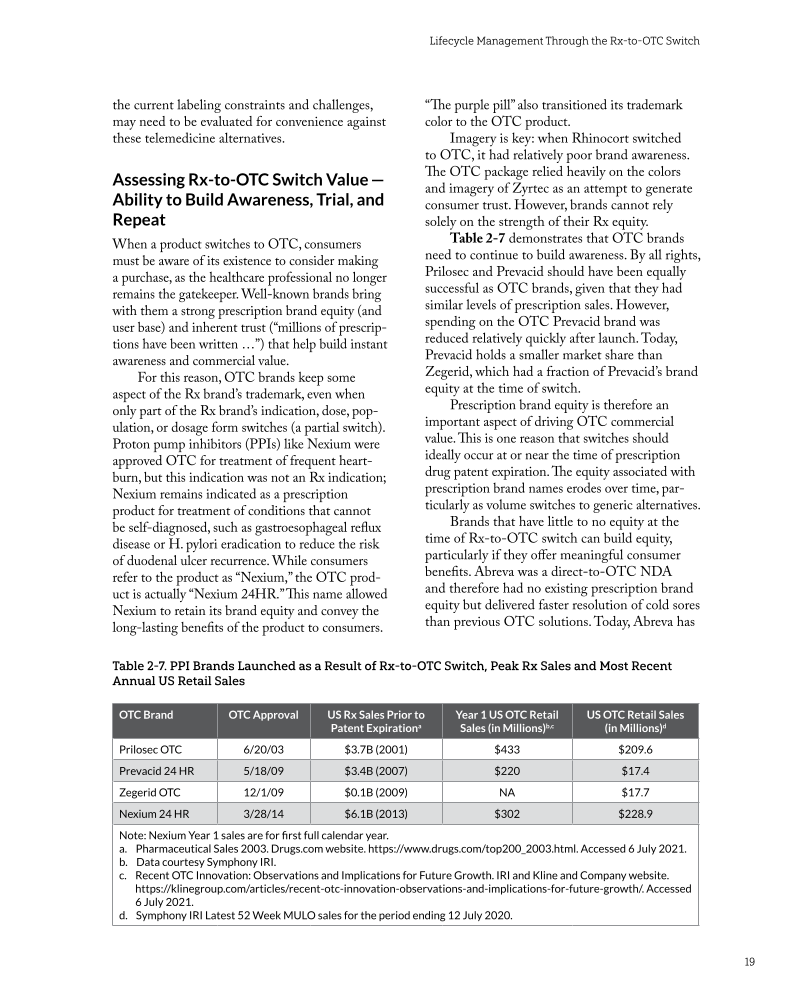
Table 2-7 demonstrates that OTC brands
need to continue to build awareness. By all rights,
Prilosec and Prevacid should have been equally
successful as OTC brands, given that they had
similar levels of prescription sales. However,
spending on the OTC Prevacid brand was
reduced relatively quickly after launch. Today,
Prevacid holds a smaller market share than
Zegerid, which had a fraction of Prevacid’s brand
equity at the time of switch.
Prescription brand equity is therefore an
important aspect of driving OTC commercial
value. This is one reason that switches should
ideally occur at or near the time of prescription
drug patent expiration. The equity associated with
prescription brand names erodes over time, par-
ticularly as volume switches to generic alternatives.
Brands that have little to no equity at the
time of Rx-to-OTC switch can build equity,
particularly if they offer meaningful consumer
benefits. Abreva was a direct-to-OTC NDA
and therefore had no existing prescription brand
equity but delivered faster resolution of cold sores
than previous OTC solutions. Today, Abreva has
Table 2-7. PPI Brands Launched as a Result of Rx-to-OTC Switch, Peak Rx Sales and Most Recent
Annual US Retail Sales
OTC Brand OTC Approval US Rx Sales Prior to
Patent Expirationa
Year 1 US OTC Retail
Sales (in Millions)b,c
US OTC Retail Sales
(in Millions)d
Prilosec OTC 6/20/03 $3.7B (2001) $433 $209.6
Prevacid 24 HR 5/18/09 $3.4B (2007) $220 $17.4
Zegerid OTC 12/1/09 $0.1B (2009) NA $17.7
Nexium 24 HR 3/28/14 $6.1B (2013) $302 $228.9
Note: Nexium Year 1 sales are for first full calendar year.
a. Pharmaceutical Sales 2003. Drugs.com website. https://www.drugs.com/top200_2003.html. Accessed 6 July 2021.
b. Data courtesy Symphony IRI.
c. Recent OTC Innovation: Observations and Implications for Future Growth. IRI and Kline and Company website.
https://klinegroup.com/articles/recent-otc-innovation-observations-and-implications-for-future-growth/. Accessed
6 July 2021.
d. Symphony IRI Latest 52 Week MULO sales for the period ending 12 July 2020.
Lifecycle Management Through the Rx-to-OTC Switch
the current labeling constraints and challenges,
may need to be evaluated for convenience against
these telemedicine alternatives.
Assessing Rx-to-OTC Switch Value —
Ability to Build Awareness, Trial, and
Repeat
When a product switches to OTC, consumers
must be aware of its existence to consider making
a purchase, as the healthcare professional no longer
remains the gatekeeper. Well-known brands bring
with them a strong prescription brand equity (and
user base) and inherent trust (“millions of prescrip-
tions have been written …”) that help build instant
awareness and commercial value.
For this reason, OTC brands keep some
aspect of the Rx brand’s trademark, even when
only part of the Rx brand’s indication, dose, pop-
ulation, or dosage form switches (a partial switch).
Proton pump inhibitors (PPIs) like Nexium were
approved OTC for treatment of frequent heart-
burn, but this indication was not an Rx indication
Nexium remains indicated as a prescription
product for treatment of conditions that cannot
be self-diagnosed, such as gastroesophageal reflux
disease or H. pylori eradication to reduce the risk
of duodenal ulcer recurrence. While consumers
refer to the product as “Nexium,” the OTC prod-
uct is actually “Nexium 24HR.” This name allowed
Nexium to retain its brand equity and convey the
long-lasting benefits of the product to consumers.
“The purple pill” also transitioned its trademark
color to the OTC product.
Imagery is key: when Rhinocort switched
to OTC, it had relatively poor brand awareness.
The OTC package relied heavily on the colors
and imagery of Zyrtec as an attempt to generate
consumer trust. However, brands cannot rely
solely on the strength of their Rx equity.
Table 2-7 demonstrates that OTC brands
need to continue to build awareness. By all rights,
Prilosec and Prevacid should have been equally
successful as OTC brands, given that they had
similar levels of prescription sales. However,
spending on the OTC Prevacid brand was
reduced relatively quickly after launch. Today,
Prevacid holds a smaller market share than
Zegerid, which had a fraction of Prevacid’s brand
equity at the time of switch.
Prescription brand equity is therefore an
important aspect of driving OTC commercial
value. This is one reason that switches should
ideally occur at or near the time of prescription
drug patent expiration. The equity associated with
prescription brand names erodes over time, par-
ticularly as volume switches to generic alternatives.
Brands that have little to no equity at the
time of Rx-to-OTC switch can build equity,
particularly if they offer meaningful consumer
benefits. Abreva was a direct-to-OTC NDA
and therefore had no existing prescription brand
equity but delivered faster resolution of cold sores
than previous OTC solutions. Today, Abreva has
Table 2-7. PPI Brands Launched as a Result of Rx-to-OTC Switch, Peak Rx Sales and Most Recent
Annual US Retail Sales
OTC Brand OTC Approval US Rx Sales Prior to
Patent Expirationa
Year 1 US OTC Retail
Sales (in Millions)b,c
US OTC Retail Sales
(in Millions)d
Prilosec OTC 6/20/03 $3.7B (2001) $433 $209.6
Prevacid 24 HR 5/18/09 $3.4B (2007) $220 $17.4
Zegerid OTC 12/1/09 $0.1B (2009) NA $17.7
Nexium 24 HR 3/28/14 $6.1B (2013) $302 $228.9
Note: Nexium Year 1 sales are for first full calendar year.
a. Pharmaceutical Sales 2003. Drugs.com website. https://www.drugs.com/top200_2003.html. Accessed 6 July 2021.
b. Data courtesy Symphony IRI.
c. Recent OTC Innovation: Observations and Implications for Future Growth. IRI and Kline and Company website.
https://klinegroup.com/articles/recent-otc-innovation-observations-and-implications-for-future-growth/. Accessed
6 July 2021.
d. Symphony IRI Latest 52 Week MULO sales for the period ending 12 July 2020.