Fundamentals of Pharmaceutical and Biologics Regulations: A Global Perspective
Second Edition
10 Regulatory Affairs Professionals Society
developmental decisions.24 Additional preclinical research may be
conducted if the medicinal product acts differently than expected.
Phase 1. Typically, Phase 1 or FIH trials represent the initial hu-
man exposure to an investigational medicine. The FIH trial of a
new treatment, which has been determined to be safe (nontoxic)
for use in animals, is usually conducted in a small group of healthy
human volunteers (i.e., 20-100 subjects). In some cases, Phase 1
trials may also be conducted in patients with the disease, for exam-
ple, for rare diseases, oncology products, or highly toxic treatments
for fatal, unmet medical needs.23
The main objective of Phase 1 is to establish a preliminary
safety profile of the investigational medicinal product, to determine
the highest dose that can be administered without causing harm, a
maximum tolerated dose (MTD) in humans, and to show that par-
ticipants can tolerate the investigational medicine. In addition,
Phase 1 trials typically assess the pharmacodynamic or “what the
drug does to the body” and pharmacokinetic (PK) profile or “what
the body does to a drug” of the investigational medicine. Phase 1
trials may also include specialized studies, such as radio-labeled
studies to establish drug metabolism and other PK parameters, car-
diovascular safety studies, hepatic and renal impairment studies,
and drug-drug interaction studies. Phase 1 trials are used to deter-
mine the most appropriate delivery mechanism (e.g., pill, solution,
injection), adequate dose, and administration schedule. Preliminary
signs of efficacy are often observed in Phase 1 trials, although not
the primary end point. Generally, Phase 1 trials are shorter than
Phase 2 trials and typically last several months to a year.
Phase 2. Building on the results from Phase 1, in Phase 2 trials the
investigational medicine is administered to patients with the disease
or condition for which the medicine is being developed. Phase 2 tri-
als typically involve several hundred participants (100-300) at multi-
ple sites and are designed to evaluate PD end points, determine
preliminary evidence of efficacy, and identify an appropriate dose
and administration schedule for evaluation and confirmation in
Phase 3. Phase 2 typically lasts approximately 2 years. Phase 2 trials
are typically referred to as nonpivotal or pilot trials.23
Sometimes, Phase 2 trials are separated into Phase 2a and 2b
trials. Phase 2a focuses on dosing requirements. Phase 2b specifi-
cally focuses on efficacy – treating, preventing, or diagnosing the
disease. In Phase 2a, a small number of participants is adminis-
tered the investigational medicine in increasing quantities after
safety is confirmed at that dose to determine a dose-response rela-
tionship. That is, to determine whether there is an increase in re-
sponse that is correlated to the dose. Additionally, the frequency
of dosing for the best response also is determined. This step is re-
ferred to as proof of concept (POC) or proof of principle (POP),
linking Phase 1 and dose-finding studies. A POC study is an im-
portant clinical development success criterion, because it demon-
strates a measurable biological effect related to the target of
interest. This effect may reasonably translate to a clinically mean-
ingful effect in later-phase clinical trials.
The primary purpose of Phase 2b, in a larger number of par-
ticipants than 2a, is to find the optimal dose with minimal side ef-
fects (dose-response studies) while keeping the therapeutic benefit
(efficacy), a critical step in the drug development continuum. It is
referred to as the definitive dose range-finding trial. Proper dosing
is critical to the effectiveness of the medicine. Phase 2b clinical tri-
als evaluate dose escalation as single ascending dose (SAD) and
multiple ascending dose (MAD) trials to identify the optimal dos-
age and dosing schedule for confirmation in Phase 3 clinical trials.
Phase 3. During Phase 3 trials, the investigational medicine is
given to a much larger group of participants (300-3,000), depend-
ing on the condition being studied, to confirm its effectiveness, to
monitor side effects, to compare it to the current standard of care,
and to collect information to allow the product to be used safely.
Phase 3 trials typically last approximately 1-4 years.23
Phase 3 trials are often randomized, multicenter trials and
typically have the longest duration, sometimes lasting years (1-4).
Randomized trials randomly assign participants to receive either
the investigational agent or an approved medicine (often the
standard of care) or placebo if no treatment exists for the investi-
gational medicine. Phase 3 trials are typically double-blind neither
participants nor investigators know which treatment is assigned.
Randomization helps eliminate bias in interpreting results. Phase 3
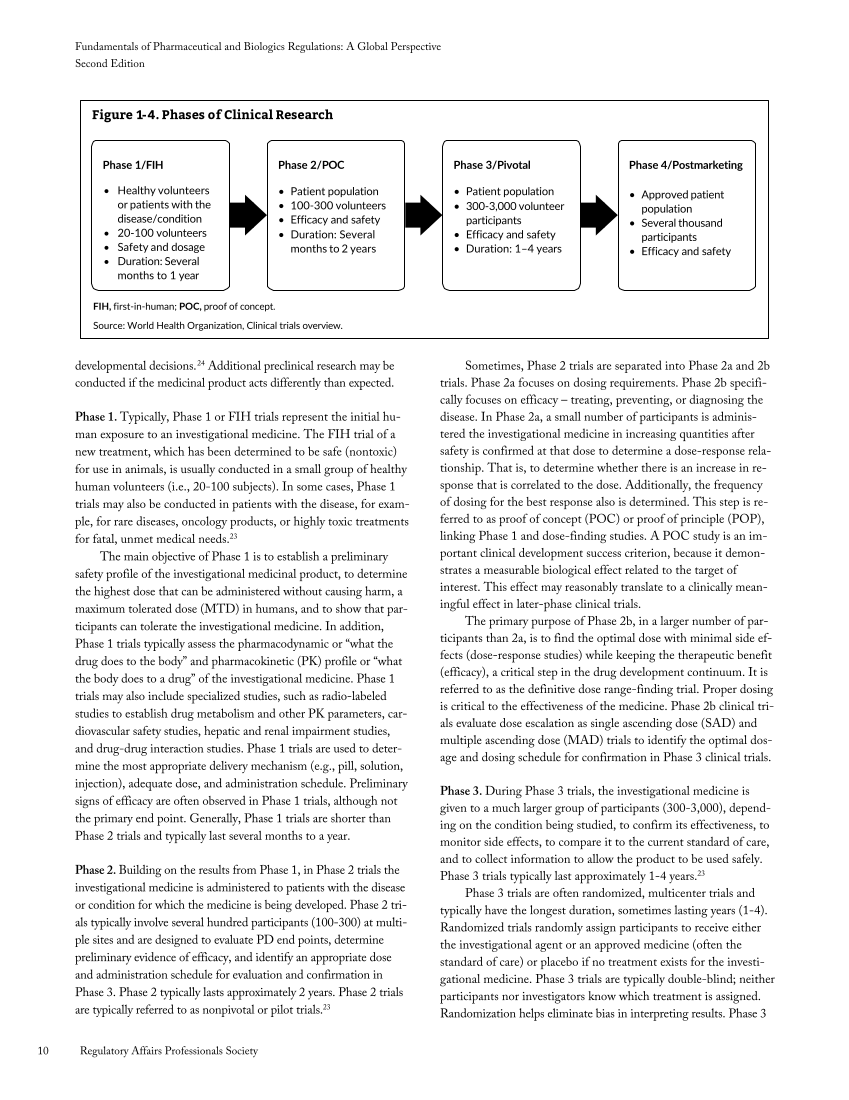
FIH, first-in-human POC, proof of concept.
Source: World Health Organization, Clinical trials overview.
Phase 4/Postmarketing
• Approved patient
population
• Several thousand
participants
• Efficacy and safety
Phase 3/Pivotal
• Patient population
• 300-3,000 volunteer
participants
• Efficacy and safety
• Duration: 1–4 years
Phase 2/POC
• Patient population
• 100-300 volunteers
• Efficacy and safety
• Duration: Several
months to 2 years
Phase 1/FIH
• Healthy volunteers
or patients with the
disease/condition
• 20-100 volunteers
• Safety and dosage
• Duration: Several
months to 1 year
Figure 1-4. Phases of Clinical Research
Second Edition
10 Regulatory Affairs Professionals Society
developmental decisions.24 Additional preclinical research may be
conducted if the medicinal product acts differently than expected.
Phase 1. Typically, Phase 1 or FIH trials represent the initial hu-
man exposure to an investigational medicine. The FIH trial of a
new treatment, which has been determined to be safe (nontoxic)
for use in animals, is usually conducted in a small group of healthy
human volunteers (i.e., 20-100 subjects). In some cases, Phase 1
trials may also be conducted in patients with the disease, for exam-
ple, for rare diseases, oncology products, or highly toxic treatments
for fatal, unmet medical needs.23
The main objective of Phase 1 is to establish a preliminary
safety profile of the investigational medicinal product, to determine
the highest dose that can be administered without causing harm, a
maximum tolerated dose (MTD) in humans, and to show that par-
ticipants can tolerate the investigational medicine. In addition,
Phase 1 trials typically assess the pharmacodynamic or “what the
drug does to the body” and pharmacokinetic (PK) profile or “what
the body does to a drug” of the investigational medicine. Phase 1
trials may also include specialized studies, such as radio-labeled
studies to establish drug metabolism and other PK parameters, car-
diovascular safety studies, hepatic and renal impairment studies,
and drug-drug interaction studies. Phase 1 trials are used to deter-
mine the most appropriate delivery mechanism (e.g., pill, solution,
injection), adequate dose, and administration schedule. Preliminary
signs of efficacy are often observed in Phase 1 trials, although not
the primary end point. Generally, Phase 1 trials are shorter than
Phase 2 trials and typically last several months to a year.
Phase 2. Building on the results from Phase 1, in Phase 2 trials the
investigational medicine is administered to patients with the disease
or condition for which the medicine is being developed. Phase 2 tri-
als typically involve several hundred participants (100-300) at multi-
ple sites and are designed to evaluate PD end points, determine
preliminary evidence of efficacy, and identify an appropriate dose
and administration schedule for evaluation and confirmation in
Phase 3. Phase 2 typically lasts approximately 2 years. Phase 2 trials
are typically referred to as nonpivotal or pilot trials.23
Sometimes, Phase 2 trials are separated into Phase 2a and 2b
trials. Phase 2a focuses on dosing requirements. Phase 2b specifi-
cally focuses on efficacy – treating, preventing, or diagnosing the
disease. In Phase 2a, a small number of participants is adminis-
tered the investigational medicine in increasing quantities after
safety is confirmed at that dose to determine a dose-response rela-
tionship. That is, to determine whether there is an increase in re-
sponse that is correlated to the dose. Additionally, the frequency
of dosing for the best response also is determined. This step is re-
ferred to as proof of concept (POC) or proof of principle (POP),
linking Phase 1 and dose-finding studies. A POC study is an im-
portant clinical development success criterion, because it demon-
strates a measurable biological effect related to the target of
interest. This effect may reasonably translate to a clinically mean-
ingful effect in later-phase clinical trials.
The primary purpose of Phase 2b, in a larger number of par-
ticipants than 2a, is to find the optimal dose with minimal side ef-
fects (dose-response studies) while keeping the therapeutic benefit
(efficacy), a critical step in the drug development continuum. It is
referred to as the definitive dose range-finding trial. Proper dosing
is critical to the effectiveness of the medicine. Phase 2b clinical tri-
als evaluate dose escalation as single ascending dose (SAD) and
multiple ascending dose (MAD) trials to identify the optimal dos-
age and dosing schedule for confirmation in Phase 3 clinical trials.
Phase 3. During Phase 3 trials, the investigational medicine is
given to a much larger group of participants (300-3,000), depend-
ing on the condition being studied, to confirm its effectiveness, to
monitor side effects, to compare it to the current standard of care,
and to collect information to allow the product to be used safely.
Phase 3 trials typically last approximately 1-4 years.23
Phase 3 trials are often randomized, multicenter trials and
typically have the longest duration, sometimes lasting years (1-4).
Randomized trials randomly assign participants to receive either
the investigational agent or an approved medicine (often the
standard of care) or placebo if no treatment exists for the investi-
gational medicine. Phase 3 trials are typically double-blind neither
participants nor investigators know which treatment is assigned.
Randomization helps eliminate bias in interpreting results. Phase 3
FIH, first-in-human POC, proof of concept.
Source: World Health Organization, Clinical trials overview.
Phase 4/Postmarketing
• Approved patient
population
• Several thousand
participants
• Efficacy and safety
Phase 3/Pivotal
• Patient population
• 300-3,000 volunteer
participants
• Efficacy and safety
• Duration: 1–4 years
Phase 2/POC
• Patient population
• 100-300 volunteers
• Efficacy and safety
• Duration: Several
months to 2 years
Phase 1/FIH
• Healthy volunteers
or patients with the
disease/condition
• 20-100 volunteers
• Safety and dosage
• Duration: Several
months to 1 year
Figure 1-4. Phases of Clinical Research