Chapter 4: Components of Regulatory Strategy – The Basics
52 Regulatory Affairs Professionals Society
Clinical Application
Questions to be answered:
• What are the clinical conditions that apply to the
device?
• Who will be using the device?
• Where will the device be used?
• How will the device be used?
• What other devices will be used with the device?
• Are there off-label uses for the product?
To understand the answers to these questions, the
regulatory professional needs to clearly understand
whether the device functions as a tool or a therapy
(see Table 4-3). Having a clear understanding of
the circumstances surrounding the use of the device
and the patient’s clinical condition is critical for a
thorough, clearly crafted, GRS. This information
can come from internal experts in the organization’s
marketing, R&D, and/or clinical groups. To be fully
informed, it is often necessary to look at outside
sources. To understand how regulatory agencies
view treatments, it is important to look for clinical
summaries or disease-specific guidance published by
regulatory agencies.
For example, in the US, current clinical prac-
tice summaries are published by both the Agency
for Healthcare Research and Quality (AHRQ) and
the Centers for Medicare and Medicaid Services.
AHRQ publishes clinical guidelines and recommen-
dations for healthcare professionals, as well as clinical
condition reports for consumers. These agencies
review a wide variety of medical interventions and
the products used for them. Their efforts are aimed at
educating healthcare professionals but also are very
useful in understanding the regulator’s perspective on
clinical use.
The location of the device’s use affects its devel-
opment and even classification. For example, a cardiac
defibrillator is used to terminate cardiac dysrhythmia.
If this device will be used by physicians in a cath-
eterization lab, the design considerations are very
different than if it will be placed in a high school gym
for the general public to use in emergencies.
It is important to remember that standard clin-
ical practices for treatments may vary from country
to country or even region to region. These differences
can be minor or major, based on the devices or drugs
currently approved or available to local healthcare
providers. Many peer-reviewed clinical publications,
such as the New England Journal of Medicine or the
Journal of the American Medical Association, are
available on the internet, but often are pay-per-view.
These global publications are good sources for under-
standing evolving research and scientific explorations
around a particular clinical condition or treatment.
It is recommended that regulatory professionals have
a solid understanding of current clinical practice
before embarking on a detailed review of published
literature. The US National Library of Medicine’s
MEDLINE/PubMed service3 provides a broad spec-
trum of resources.
Even if a regulatory professional believes he or
she has a good understanding of the clinical con-
dition being treated, it is always a good idea to find
resources that provide the most up-to-date informa-
tion about the condition.
Technology and Engineering
Questions to be answered:
• Is this a new technology?
• Is this a new application of existing technology?
• Is the technology used in other devices?
• What materials are used in the device?
• What problems have been reported with existing
devices using the same technology?
• Does the application of technology pose any new
questions or risks?
• What evidence is needed to support regulatory
approvals in each target market?
Because regulatory professionals come from a wide
variety of backgrounds, from biology to engineering
to psychology, it is important to establish a broad base
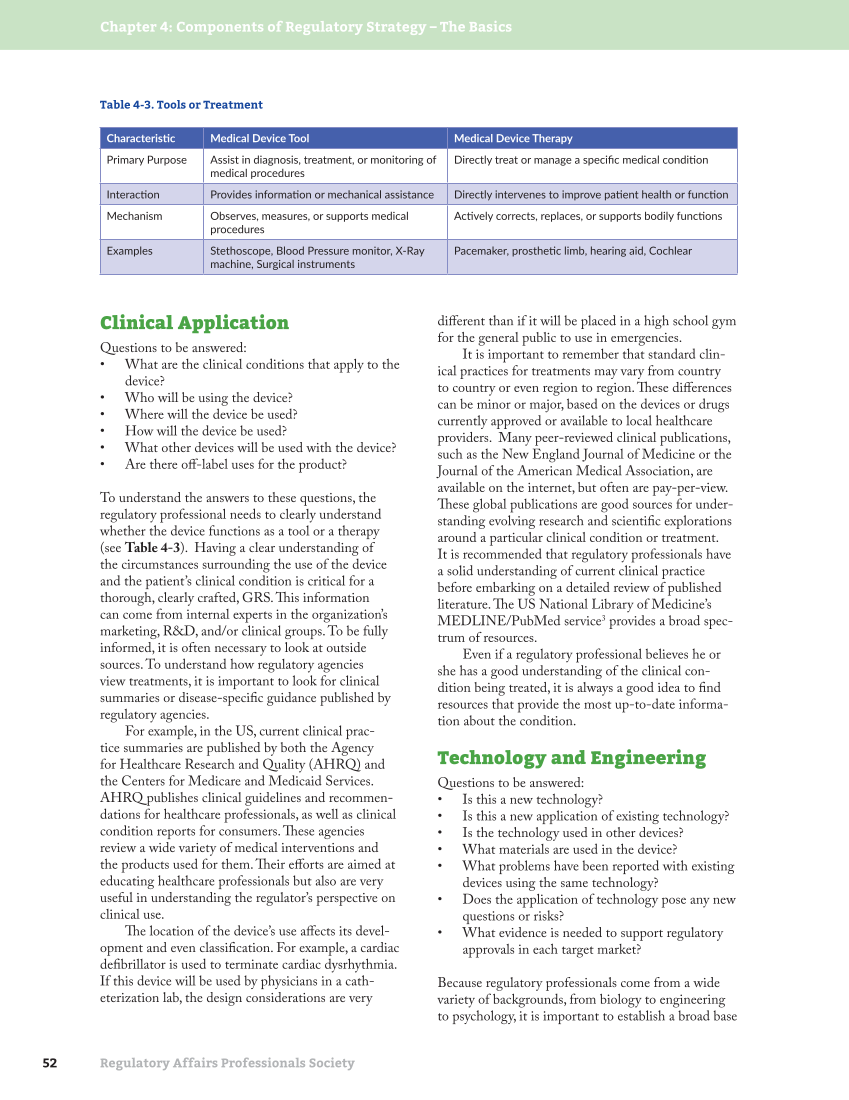
Table 4-3. Tools or Treatment
Characteristic Medical Device Tool Medical Device Therapy
Primary Purpose Assist in diagnosis, treatment, or monitoring of
medical procedures
Directly treat or manage a specific medical condition
Interaction Provides information or mechanical assistance Directly intervenes to improve patient health or function
Mechanism Observes, measures, or supports medical
procedures
Actively corrects, replaces, or supports bodily functions
Examples Stethoscope, Blood Pressure monitor, X-Ray
machine, Surgical instruments
Pacemaker, prosthetic limb, hearing aid, Cochlear
52 Regulatory Affairs Professionals Society
Clinical Application
Questions to be answered:
• What are the clinical conditions that apply to the
device?
• Who will be using the device?
• Where will the device be used?
• How will the device be used?
• What other devices will be used with the device?
• Are there off-label uses for the product?
To understand the answers to these questions, the
regulatory professional needs to clearly understand
whether the device functions as a tool or a therapy
(see Table 4-3). Having a clear understanding of
the circumstances surrounding the use of the device
and the patient’s clinical condition is critical for a
thorough, clearly crafted, GRS. This information
can come from internal experts in the organization’s
marketing, R&D, and/or clinical groups. To be fully
informed, it is often necessary to look at outside
sources. To understand how regulatory agencies
view treatments, it is important to look for clinical
summaries or disease-specific guidance published by
regulatory agencies.
For example, in the US, current clinical prac-
tice summaries are published by both the Agency
for Healthcare Research and Quality (AHRQ) and
the Centers for Medicare and Medicaid Services.
AHRQ publishes clinical guidelines and recommen-
dations for healthcare professionals, as well as clinical
condition reports for consumers. These agencies
review a wide variety of medical interventions and
the products used for them. Their efforts are aimed at
educating healthcare professionals but also are very
useful in understanding the regulator’s perspective on
clinical use.
The location of the device’s use affects its devel-
opment and even classification. For example, a cardiac
defibrillator is used to terminate cardiac dysrhythmia.
If this device will be used by physicians in a cath-
eterization lab, the design considerations are very
different than if it will be placed in a high school gym
for the general public to use in emergencies.
It is important to remember that standard clin-
ical practices for treatments may vary from country
to country or even region to region. These differences
can be minor or major, based on the devices or drugs
currently approved or available to local healthcare
providers. Many peer-reviewed clinical publications,
such as the New England Journal of Medicine or the
Journal of the American Medical Association, are
available on the internet, but often are pay-per-view.
These global publications are good sources for under-
standing evolving research and scientific explorations
around a particular clinical condition or treatment.
It is recommended that regulatory professionals have
a solid understanding of current clinical practice
before embarking on a detailed review of published
literature. The US National Library of Medicine’s
MEDLINE/PubMed service3 provides a broad spec-
trum of resources.
Even if a regulatory professional believes he or
she has a good understanding of the clinical con-
dition being treated, it is always a good idea to find
resources that provide the most up-to-date informa-
tion about the condition.
Technology and Engineering
Questions to be answered:
• Is this a new technology?
• Is this a new application of existing technology?
• Is the technology used in other devices?
• What materials are used in the device?
• What problems have been reported with existing
devices using the same technology?
• Does the application of technology pose any new
questions or risks?
• What evidence is needed to support regulatory
approvals in each target market?
Because regulatory professionals come from a wide
variety of backgrounds, from biology to engineering
to psychology, it is important to establish a broad base
Table 4-3. Tools or Treatment
Characteristic Medical Device Tool Medical Device Therapy
Primary Purpose Assist in diagnosis, treatment, or monitoring of
medical procedures
Directly treat or manage a specific medical condition
Interaction Provides information or mechanical assistance Directly intervenes to improve patient health or function
Mechanism Observes, measures, or supports medical
procedures
Actively corrects, replaces, or supports bodily functions
Examples Stethoscope, Blood Pressure monitor, X-Ray
machine, Surgical instruments
Pacemaker, prosthetic limb, hearing aid, Cochlear